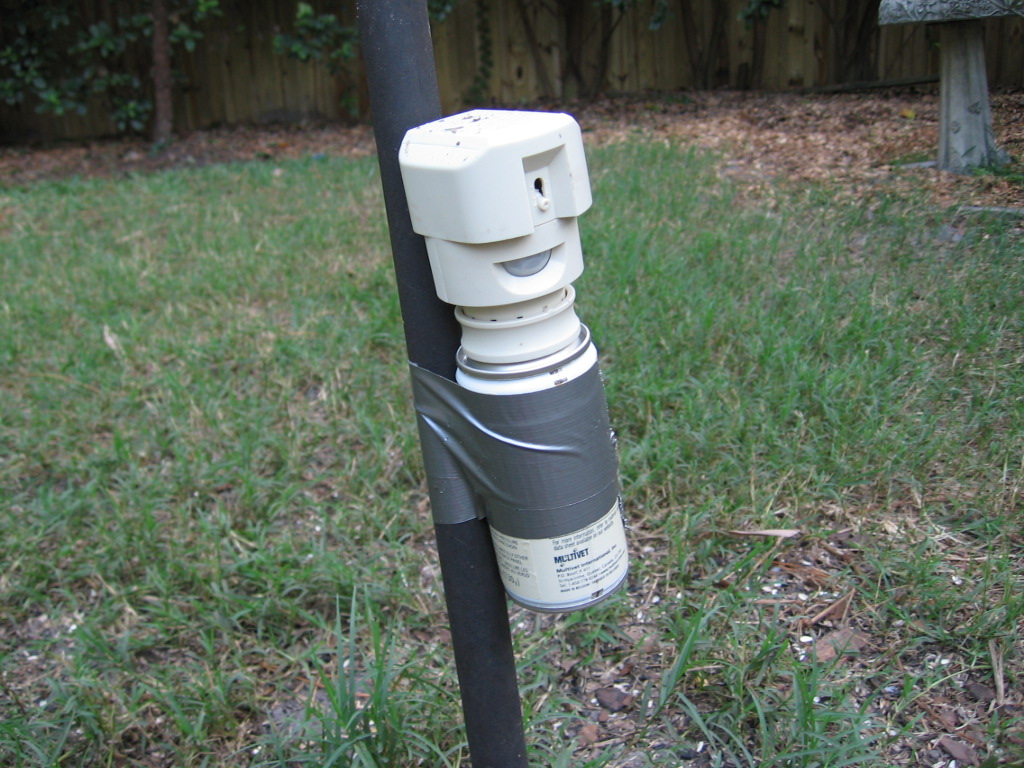
Ssscat!

My friends, let me tell you about an amazing product. We’ve had constant problems with the dogs scarfing bird seed and other nefarious items under the bird feeder. We tried to spray them with water, blew an air horn (sorry neighbors), we used verbal commands – nothing stopped them from this unwelcome behavior. Until we purchased Ssscat. Ssscat is a can of air with a motion detector. When the dogs got close to the feeder, the air would spray and they would run for the hills. Each dog experienced two sprays – and let me tell you, nary a seed has been eaten since that time. In fact, we’ve turn it off because we don’t need it to spray anymore.

So, if you’ve had a similar problem – Ssscat might be the answer.

The son of William F. Buckley has decided—shock!—to vote for a Democrat.

Read Buckley’s statement from The Daily Beast endorsing Obama here. Some quotes:

I’ve read Obama’s books, and they are first-rate. He is that rara avis, the politician who writes his own books. Imagine. He is also a lefty. I am not. I am a small-government conservative who clings tenaciously and old-fashionedly to the idea that one ought to have balanced budgets. On abortion, gay marriage, et al, I’m libertarian. I believe with my sage and epigrammatic friend P.J. O’Rourke that a government big enough to give you everything you want is also big enough to take it all away.

Obama has in him—I think, despite his sometimes airy-fairy “We are the people we have been waiting for” silly rhetoric—the potential to be a good, perhaps even great leader. He is, it seems clear enough, what the historical moment seems to be calling for.

McCain a Radical?

An editorial from the NY Sun in 2006. An excerpt:

Many years had passed since then, and I bore little animosity for anyone because of what they had done or not done during the Vietnam War.

This is a quote from John McCain in May 2006 during a commencement speech at Columbia College. McCain was recounting the story of one David Ifshin who, in 1970, was a war protester and travelled to Hanoi with Jane Fonda and broadcast remarks over Radio Hanoi. McCain indicated he heard the broadcast while he was a POW. Ifshin was called a traitor at the time. He was accused of being responsible for more American deaths.

McCain stated that he and Ifshin reconciled and later worked together for an organization that promoted human rights in Vietnam.

I came to admire him for his generosity, his passion for his ideals, for the largeness of his heart, and I realized he had not been my enemy, but my countryman . . . my countryman …and later my friend.

Boy, this story sounds amazingly familiar. But wait, wasn’t Ifshin a “radical”?

John McCain – you’re a hypocrite.

Thieves Among Us

A co-worker of mine woke up this morning to find his “Obama for President” sign has been removed from his. Upon looking around he noticed that ALL Obama signs from his neighborhood had been removed. He wrote a letter to the Gainesville Sun and copied me on it:

During the evening of October 13, someone, or some group of individuals, stole every Obama for President lawn sign from Deer Run, the subdivision in which I reside. When I realized that my sign was also gone, I was immediately angered that someone would infringe upon my right to freely express my opinion, and especially when doing so on my own property. I also became determined to spread the word about the thefts and the apparent hypocrisy that I see from this crime, which is invigorating me to not let these scoundrelous tactics stifle my opinion.

Since the target of all the thefts were Obama signs, I think we can conclude that the thieves are McCain supporters, or at least right-leaning in their ideology, and as a result a few ironic observations came to mind. Foremost is the fact that the republican party is tightly aligned with religion, especially in the southeastern United States. How ironic is it that someone representing the party of religion is stealing signs in the middle of the night. Do you not practice “Thou shalt not steal”, or does that not apply in your campaign against Obama? Just as grand of an irony is the fact that many right-leaning people favor strict law enforcement and harsh punishment, in order to deter criminal behavior. Yet, here they are stealing signs in the middle of the evening.

So bravo anti-Obama, sign stealing people. By your actions, you expose the hypocrisy that underlies the foundations of your personal ideological beliefs, and at a minimum you motivated me, and perhaps others, to be more involved with this and future campaigns.

G. Bouchard

"He Lied" About Bill Ayers?

If you’re thinking of voting for John McCain because you believe Obama to be a “radical”, read this article. It’s from the well respected and non-partisan FactCheck.org .

Below is the Conclusion of the article: Read complete article here.

Voters may differ in how they see Ayers, or how they see Obama’s interactions with him. We’re making no judgment calls on those matters. What we object to are the McCain-Palin campaign’s attempts to sway voters – in ads and on the stump – with false and misleading statements about the relationship, which was never very close. Obama never “lied” about this, just as he never bragged about it. The foundation they both worked with was hardly “radical.” And Ayers is more than a former “terrorist,” he’s also a well-known figure in the field of education.

Annenberg Political Fact Check

From FactCheck.org

Our Mission

We are a nonpartisan, nonprofit “consumer advocate” for voters that aims to reduce the level of deception and confusion in U.S. politics. We monitor the factual accuracy of what is said by major U.S. political players in the form of TV ads, debates, speeches, interviews and news releases. Our goal is to apply the best practices of both journalism and scholarship, and to increase public knowledge and understanding.

The Annenberg Political Fact Check is a project of the Annenberg Public Policy Center of the University of Pennsylvania. The APPC was established by publisher and philanthropist Walter Annenberg in 1994 to create a community of scholars within the University of Pennsylvania that would address public policy issues at the local, state and federal levels.

The APPC accepts NO funding from business corporations, labor unions, political parties, lobbying organizations or individuals. It is funded primarily by the Annenberg Foundation.

The Real Risk Of McCain’s Health Plan

From National Journal Magazine:

It’s not the taxes — it’s the erosion of risk-sharing between the healthy and the sick.
by Ronald Brownstein

Saturday, Oct. 11, 2008

This week’s most important debate wasn’t the meandering town hall duel between Barack Obama and John McCain. That encounter was understandably scored by polls and most pundits as a win for Obama, who seemed steadier than an over-caffeinated McCain. But lackluster questions and a constrictive format meant it did little to clarify the decision facing voters.

Far more instructive was the argument Obama instigated with McCain last week over health care. In several speeches, Obama accurately framed the central contrast between the nominees’ approaches. The bedrock goal of Obama’s plan is to reinforce the sharing of risk and cost between healthy and sick, young and old. By contrast, McCain, hoping to expand choice, would erode risk-sharing and accept sharper distinctions between the healthy and sick in both the availability and cost of coverage. One plan prizes solidarity; the other, autonomy.

Most Americans now receive their health insurance at work. That system promotes risk-sharing because employers don’t vary the premiums based on a worker’s age or health: The old and sick are subsidized by the young and healthy, who are then subsidized as they age.

McCain would upend that system. Today employers can deduct as a business expense the contributions they make to a worker’s health insurance premiums. Workers, though, are not taxed on the value of their employer’s contribution. That “exclusion” provides a powerful tax incentive for work-based coverage. McCain would end the exclusion so that workers pay taxes on their employer’s premium contribution. Instead, he would provide a tax credit ($2,500 for individuals and $5,000 for families) that workers could apply to the cost of obtaining health insurance. In an ad this week, the Obama campaign described that trade as “the largest middle-class tax increase in history.”

That’s flat wrong. For all but the highest earners with the most-expensive insurance plans, the credit would more than offset the additional taxes workers would face from ending the exclusion, the nonpartisan Tax Policy Center calculates. The real problem with McCain’s idea is that, without the economic incentive provided by the exclusion, more employers might stop offering coverage. And even employers who want to continue could find it difficult because younger workers would be likely to use their credit to buy stripped-down, cheaper coverage on their own. That would leave employers covering only older and sicker workers, which could quickly swell premiums to unaffordable levels. That concern prompted the U.S. Chamber of Commerce and the Business Roundtable to criticize McCain’s plan in an eye-opening New York Times article on Tuesday.

McCain’s camp insists that his proposal would not undermine employer-based coverage. But few experts agree. Several studies have projected that his plan would move about 20 million people from employer-based coverage to the individual insurance market. And in that market, older or sicker consumers face much higher costs than the healthy — if they can buy coverage at all.

McCain would further deregulate the individual market by allowing any insurance policy approved in any state to be sold in every state. He says that would provide consumers more choices, but it would also undercut state laws requiring insurers to cover specific treatments, like cervical or breast cancer screening for women. An insurer could locate in the one state that does not require it to fund mammograms (Utah) and sell in all 50 states. Even more worrisome, notes health economist Jonathan Gruber, is that insurance companies offering more-comprehensive policies for individuals would face the same risk as employers — losing healthy young workers to cut-rate plans from the least-regulated states. That would further unravel risk-sharing and increase prices for the sick.

Obama’s goals couldn’t differ more. Through incentives for (and mandates on) employers, the expansion of government programs, and new nationwide rules for insurers (such as requiring them to cover all applicants, regardless of their health), he wants to insure more Americans through large pools that promote risk-sharing.

McCain’s approach would save people money when they are young but expose them to greater financial and health risks as they age. It repudiates the essence of insurance, which aims to spread risk not only across the population but across an individual’s lifetime. Obama is wrong to portray McCain’s plan as a tax hike. And the Democrat’s alternative raises its own tough questions, especially about cost. But Obama does not exaggerate when he says that his rival is offering a “radical” new vision of how Americans can safeguard their health.