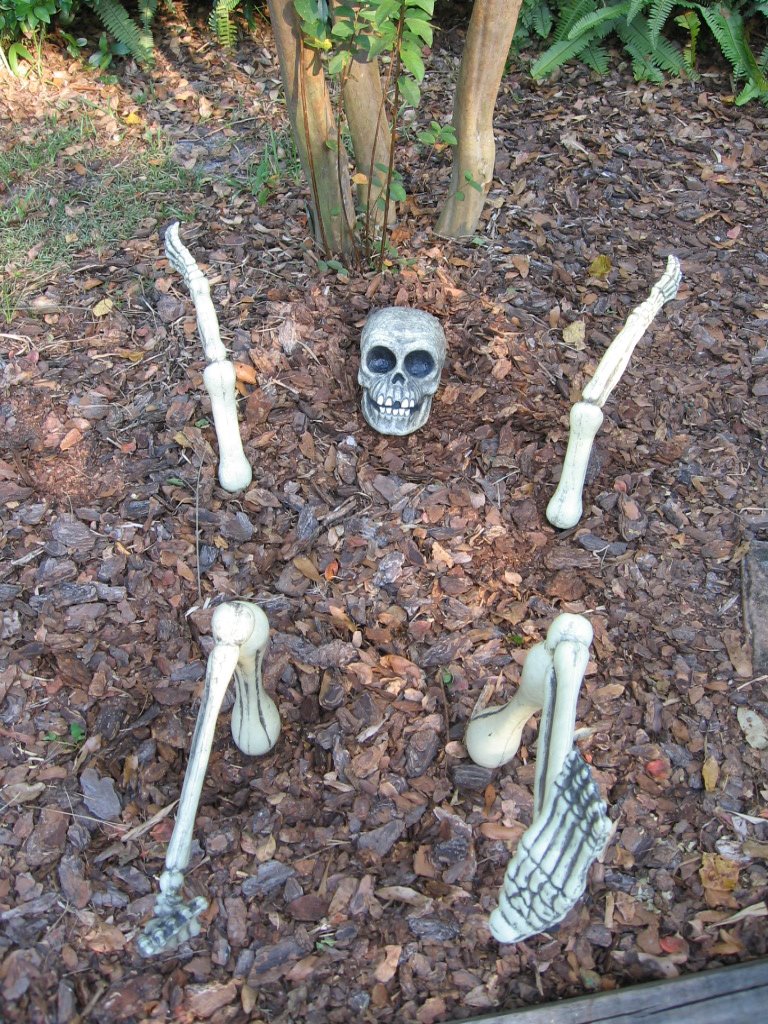
If you live in our house then October 1 means Halloween is right around the corner. So, the first weekend of the month means pulling out all the stuff and setting up in the front yard. We’ve added Dead Donna to our repertoire – weather permitting, we think we can pull it off (that is, scare the bejeebees out of our trick or treaters).
Right on target
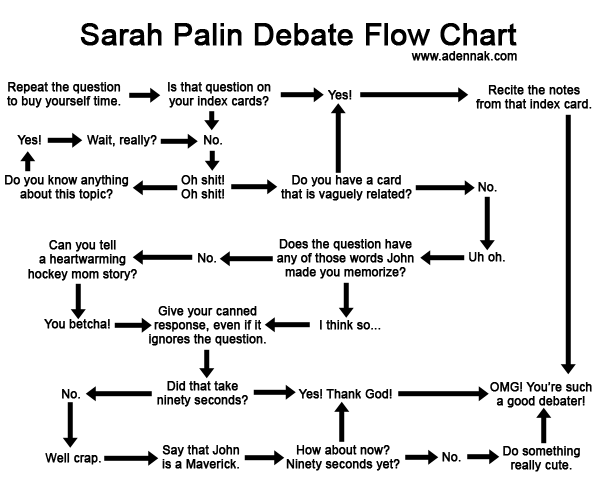
Courtesy of adennak:
Another one bites the dust…

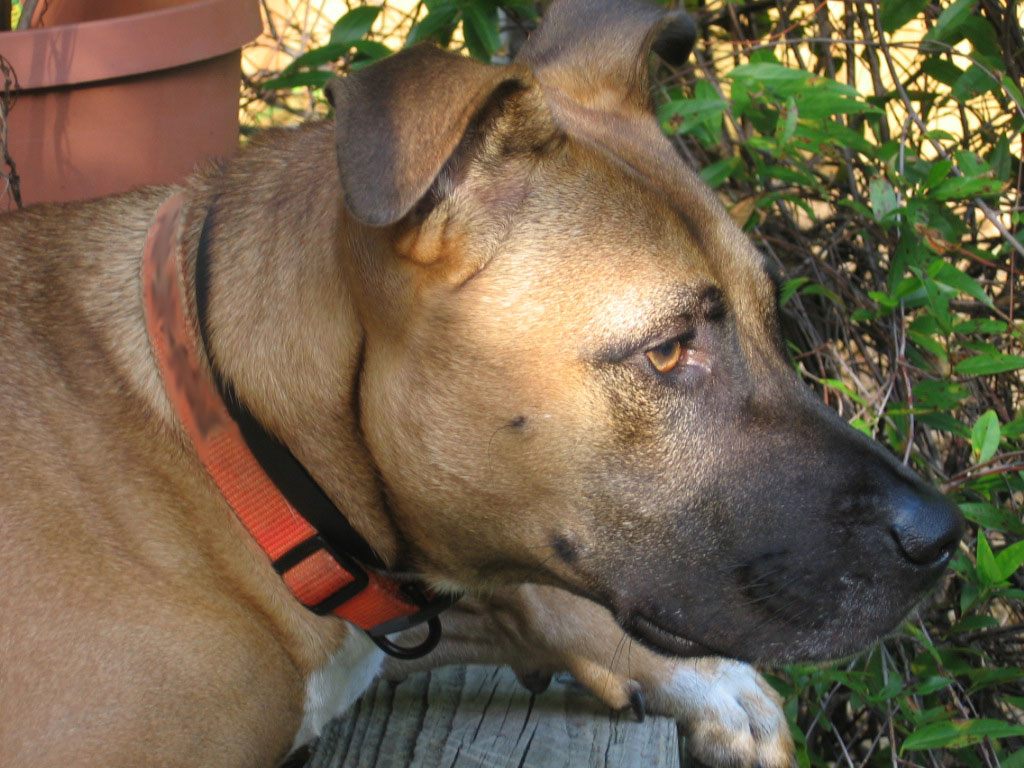
It is with sadness that I report the death of a neighborhood squirrel. At approximately 7:30am EST, “Nuts” expired after suffering trauma related injuries. The perp is a 2 year old Florida brown dog named Peanut. Peanut is currently under house arrest and supervision. Her punishment will be meted out this weekend when her collar will be fitted with a bell – the length of this punishment is yet to be determined but is expected to last many years.
Change of Pace
Every year the UF Music school has a brazilian music week where musical artists come to give master classes and to perform in concert at the end of the week. Mir and I have attended the concerts from two of the last three years – they’ve been exceptional. Here is Ulisses Rocha who came this year, along with another artist. The concert they gave was wonderful. Ulisses played this song at the concert – it’s beautiful. When I need to chill, I’ll play it – on my iPod – not on a guitar. Enjoy.
"Debates proved twinkle trumps facts"
Andrew Halcro is a former Republican legislator who ran for governor in 2006 as an Independent. He participated in debates with Sarah Palin and another candidate. His commentary is very interesting. It was published in the Anchorage Daily News. Here’s an excerpt:
On April 18, 2006, Palin and I sat together in a hotel coffee shop comparing campaign trail notes. As we talked about the debates, Palin made a comment that highlights the phenomenon that Biden is up against.
“Andrew, I watch you at these debates with no notes, no papers and yet when asked questions you spout off facts, figures and policies and I’m amazed. But then I look out into the audience and I ask myself, ‘Does any of this really matter?’ ” Palin said.
While public policy wonks might cringe, the fact was that Sarah Palin was simply vocalizing her biggest campaign strength without realizing it. During the campaign, from January to November, Palin’s message on important public policy issues never evolved — because it didn’t have to. Her ability to fill the debate halls with her presence and her gift of the glittering generality made it possible for her to rely on populism instead of policy.
In one debate, a moderator asked the candidates to name a bill the Legislature had recently passed that we didn’t like. I named one. Democratic candidate Tony Knowles named one. But Palin used her allotted time to criticize the unpopular incumbent governor, Frank Murkowski. Asked to name a bill we did like, the same pattern emerged: Palin didn’t name a bill.
And when she does answer the actual question asked, she has the canny ability to connect with the audience on a personal level. For example, asked to name a major issue that had been ignored during the campaign, I mentioned the health of Alaska communities, Mr. Knowles talked about affordable health care, and Palin talked about the need to protect hunting and fishing rights.
We’ll see how she does – I’m hoping she’ll give Tina Fey some ideas for her next skit on SNL.
Will Palin Crash and Burn Tonight? Probably not.
From The AnonymousLiberal’s blog:
Honestly, though, I don’t expect Palin will be as bad as she was with Couric. What made the Couric interviews so devastating was Couric’s tendency (which is actually rare among reporters) to ask follow up questions when she got a non-responsive answer. When Palin would filibuster, Couric would repeat the question or press her for specifics. That’s what elicited her most embarrassing responses.
But the format of the debate won’t allow for those kind of follow up questions. Palin can be as non-responsive as she pleases. Moreover, on at least half the questions, Biden will have to answer first, which will give Palin time to think about her answer and allow her to build off whatever Biden says. And finally, the questions aren’t likely to be out of left field. There’s a lot of ground to cover and not much time to do it, so it’s very likely that all of the questions she’ll be asked will have been anticipated by her coaches and she’ll have set answers ready.
In other words, unless she completely psyches herself out and blanks out up there, she’s likely to turn in at least a mediocre performance.
SNL – Another Interview with Sarah Palin
http://www.nbc.com/assets/video/widget/widget.html?vid=n12311
You can watch the first SNL skit here.
Fascinating Discussion on Bill Moyers’s Journal
A quote from the discussion:
Well, I’ve been troubled by the course of U.S. foreign policy for a long, long time. And I wrote the book in order to sort out my own thinking about where our basic problems lay. And I really reached the conclusion that our biggest problems are within.
I think there’s a tendency on the part of policy makers and probably a tendency on the part of many Americans to think that the problems we face are problems that are out there somewhere, beyond our borders. And that if we can fix those problems, then we’ll be able to continue the American way of life as it has long existed. I think it’s fundamentally wrong. Our major problems are at home.
This is not an election story. It’s a “let’s face reality” story – click here to go to the video or podcast – the video is in two parts. This discussion will make you pause and reassess what’s important – looking at yourself in the mirror may be a little more difficult – I urge you to take time to sit down, with no interruptions, and watch or listen to this entire discussion – it’s well worth it
Thoughts on the Debates
Okay, I’ve talked some about how we needed to have the debate this evening between McCain and Obama.
Although, we should get some sense of the candidates positions on certain issues from tonight’s festivities, it’s a far cry from the kind of debate it should be.
An excerpt from OpenDebate.org:
The Presidential debates — the single most important electoral event in the process of selecting a President — should provide voters with an opportunity to see the popular candidates discussing important issues in an unscripted manner. But the Presidential debates fail to do so, because the major party candidates secretly control them.
Presidential debates were run by the civic-minded and non-partisan League of Women Voters until 1988 [read their letter withdrawing sponsorship], when the national Republican and Democratic parties seized control of the debates by establishing the bi-partisan, corporate-sponsored Commission on Presidential Debates (CPD). Posing as a nonpartisan institution committed to voter education, the CPD has continually and deceptively run the debates in the interest of the national Republican and Democratic parties, not the American people.
Every four years, negotiators for the Republican and Democratic nominees secretly draft debate contracts called Memoranda of Understanding [view the 2004 version] that dictate precisely how the debates will be structured; co-chaired by the former heads of the Republican and Democratic parties, the CPD obediently implements the contracts, shielding the major party candidates from public criticism.
Such deceptive major party control severely harms our democracy. Candidates that voters want to see are often excluded; issues the American people want to hear about are often ignored; the debates have been turned into a series of glorified bipartisan news conferences, in which the candidates exchange memorized soundbites; and debate viewership has generally dropped, with twenty-five million fewer people watching the 2000 presidential debates than watching the 1992 presidential debates. Walter Cronkite called CPD-sponsored presidential debates an “unconscionable fraud.”
Open Debates has helped establish a truly nonpartisan Citizens’ Debate Commission comprised of national civic leaders to sponsor presidential debates that are rigorous, fair, and inclusive of important issues and popular candidates. The higher values of democracy and voter education will be restored to the presidential debates by the Citizens’ Debate Commission.